
Tariffs: The Great Global Reset
Trump's Reciprocal Policies Dismantle Decades-Old Trade Rules, Ushering in a New Era of Global Economic Rebalancing and Market Opportunities Amid Underestimated Risks

Since the reciprocal tariff policies kicked in back in April, U.S. stocks have overestimated the impact of tariffs—after a sharp sell-off, the index has since rallied to a new all-time high once again.
Meanwhile, A-shares and Hong Kong stocks seem to have grown desensitized to the tariff shocks, spurred by robust H1 export growth and the steady RMB exchange rate.
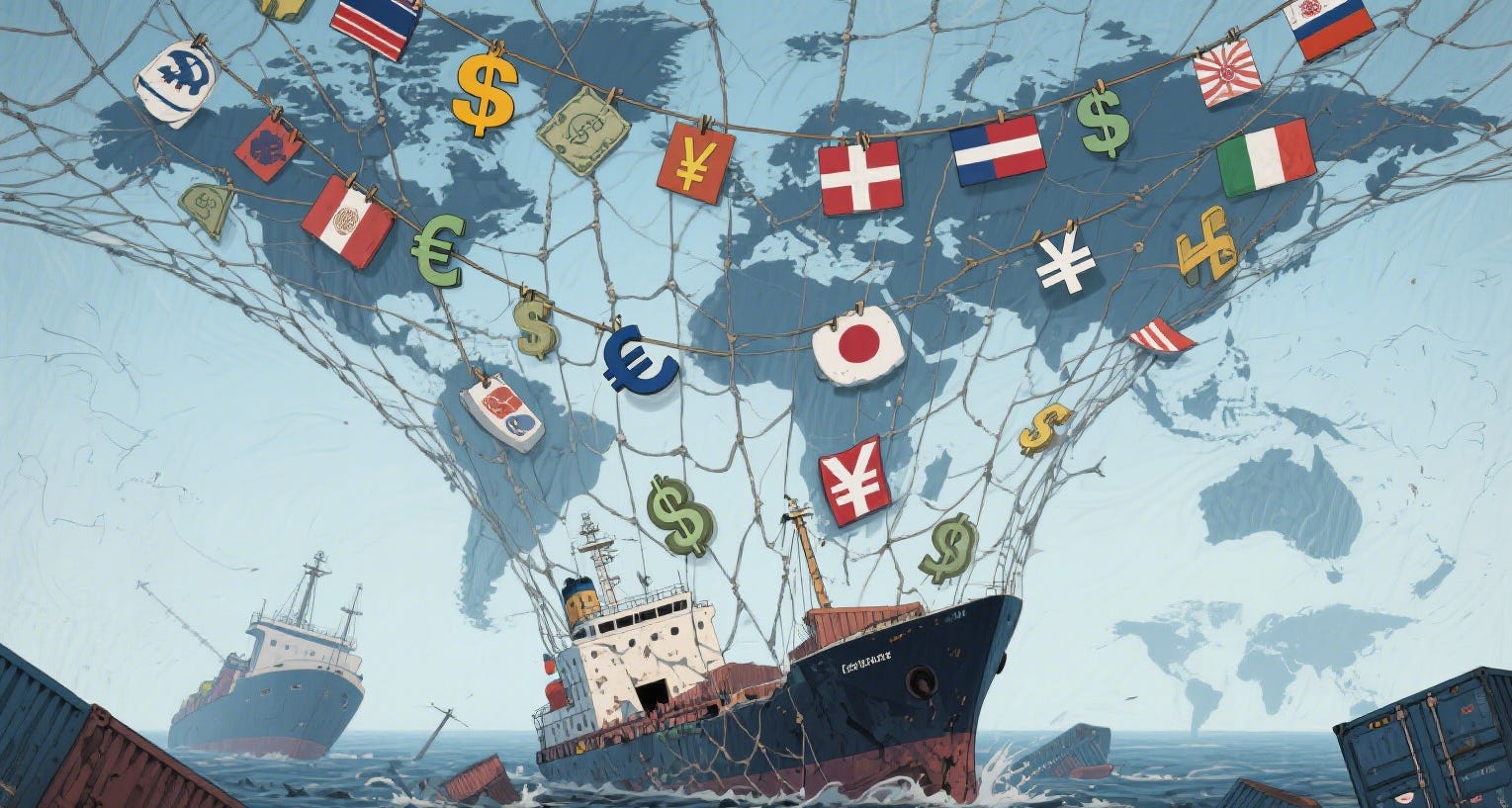
On August 1, the U.S. government rolled out a new set of tariff rates. The market hasn't fully grasped that this policy has fundamentally upended international trade rules dating back to the 1946 General Agreement on Tariffs and Trade. It signals the official emergence of a new global trade order, one that will progressively reshape international trade patterns and global supply chains.
However, right now, the market is underestimating this risk.
Global Trade New Order
On August 1, the Office of the United States Trade Representative (USTR) released the latest "reciprocal tariff" schedule, which will take effect on August 7.
Countries facing the highest rates are those that haven't sealed deals with the U.S. yet. This includes nations with weaker governance, like Syria at 41%, Laos at 40%, and Myanmar at 40%. Even developed countries aren't spared, with Switzerland and Canada getting slapped with punitive tariffs of 39% and 35%, respectively.
Moreover, India and Mexico haven't wrapped up negotiations with the U.S., both staring down 25% rates. Mexico's case is a bit trickier, with a 90-day delay, and the rate's expected to dip to 20%.
India's in a tougher spot—Trump figures India snapped up huge volumes of Russian oil during the Russia-Ukraine war, and he's vowed to hike tariffs sharply on Indian products. That said, both are likely to hammer out agreements in the end, dropping the U.S. rate on India to around 20%.
Countries that have already struck deals with the U.S. are generally seeing tariff rates between 15% and 20%. Among them, Asian exporters tend to be on the higher end: Vietnam at 20%, and Cambodia, Indonesia, Malaysia, the Philippines, and Thailand all at 19%.
Developed countries and economies are a bit lower, with the EU, Japan, and South Korea each at 15%. Chinese Taipei is set at 20%, 5 points above its chip-export rival Korea.
Trade talks between the U.S. and China are still ongoing, and as other nations seal their agreements with the U.S., the pressure on China to negotiate will ramp up. It's expected that the two sides will reach a deal, potentially dropping the final tariff rate from the current 30%-plus level to around 25%.
Compared to the initial policy rolled out in April, these new rates are noticeably lower, and we can expect further reductions for individual countries down the line. In other words, they'll only go down, not up.
The rollout of this policy marks the breakdown of the international trade order established by the 1946 General Agreement on Tariffs and Trade (which later evolved into the WTO), ushering in a new set of global trade rules.
The answer goes back to the 1946 General Agreement on Tariffs and Trade (GATT). At its core was a policy of non-discriminatory tariffs, which drove a rapid drop in global tariff rates that followed, in turn spurring explosive growth in international trade.
But the policy rolled out on August 1 introduces discriminatory tariffs instead. This doesn't just push up global tangible tariff rates—it directly dismantles the World Trade Organization (WTO) framework built on GATT. As a result, we're witnessing a historic global transformation on a century-long scale.
But the market seems to be deliberately or inadvertently overlooking this "once-in-a-century shift." There might be two reasons behind this:
Underestimating Trump: A lot of folks see Trump as just a clown or a tyrant, figuring his policies will ultimately buckle under public opinion, the tide of the times, and economic laws.
Illusion of global economic resilience: In the first half of the year, major global economies posted better-than-expected growth and export figures, lulling many into a false sense of optimism and causing them to ignore underlying structural risks.
This tariff war isn't just a trade spat—it's a full-on reconfiguration of the global trade order, and new trade rules are bound to take shape.
A lot of people look back on the past era of economic globalization as something wonderful, but they miss the key problem with this wave of globalization—economic imbalance. That imbalance comes from price distortions, and those distortions stem from flaws in the rules of globalization.
The World Trade Organization (WTO) has long grappled with two core issues:
The WTO has sped up the global flow of capital, but it's done nothing for the global movement of labor. This mismatch has warped labor prices, steadily widening the income gap between capital and labor around the world.
Even though the WTO has pushed down tangible tariffs, intangible tariffs (or hidden ones) stay sky-high.
Plenty of folks figure that under WTO rules, global tariff rates are low. And yeah, visible tariffs—like the zero tariffs the U.S. has held onto for ages—have indeed sunk to rock-bottom levels.
But they don't realize that while tangible tariffs have been steadily dropping, intangible ones have stayed stubbornly high. If you factor those intangible tariffs in, the actual tariff rates during the last wave of globalization weren't low at all.
So, what exactly are intangible tariffs?
Intangible tariffs, also known as non-tariff barriers, refer to all policies that interfere with trade beyond actual tariffs. For example:
Import quotas
Trade subsidies
Exchange controls
Capital controls
Labor protection issues
The reciprocal tariff rates initially announced by the Trump administration were calculated by converting those non-tariff barriers into equivalent tariff rates and then halving them to set the rates for each country. Since many Asian nations in transition have high non-tariff barriers, they've become the hardest hit in this tariff war.
Worse still, you've got tangible tariffs on a constant decline on one side, and intangible tariffs through the roof on the other. This imbalance between the two has directly warped prices for goods, raw materials, labor, and financial markets on the international stage, ultimately sparking imbalances in global trade and the economy.
Under this imbalanced setup, countries with low tangible tariffs often wind up stuck in chronic trade deficits that just keep ballooning. Their homegrown factory owners and workers take the biggest hit, while giant multinationals, tech giants, and financial firms come out as the main winners.
On the flip side, countries with high intangible tariffs usually rack up persistent and growing trade surpluses, where manufacturing companies benefit, and workers generally feel like they're coming out ahead.
So, how do we wrap our heads around this new global trade order? If the General Agreement on Tariffs and Trade was founded on the drop in tangible tariffs, then the new international trade order is built on the decline of intangible tariffs (non-tariff barriers).
Coming out of this trade war, global tangible tariffs are climbing, while intangible ones are dropping—particularly as Asian nations steadily trim their non-tariff barriers, pushing intangible tariffs even lower.
Excluding intangible tariffs, global overall tariff rates will tick up a bit from before, but when you include them, the rates are actually coming down.
Notably, the drop in non-tariff barriers will spur financial openness, market growth, rule of law advancements, and modern state transitions in goods-exporting nations.
Reassessing Tariff Impacts
The U.S. market overestimated the hit from this round of tariff wars—U.S. second-quarter GDP crushed expectations, inflation clocked in well below forecasts, and stocks, after a nerve-wracking dip, reclaimed lost ground and are now scaling new all-time highs.
How should we think about the effects of tariff hikes on the economy and inflation?
First, we need to understand what taxation means. Taxation is when the government extracts funds from the market. Once the new policy is implemented on August 1, the overall U.S. tariff rate is expected to be about 18%. This will result in the government pulling roughly $200 billion from the market each year.
When a lot of people see this number, their first reaction is: Who's really footing the bill? Is it American consumers, U.S. importers (retailers), or exporters from other countries?
These three scenarios lead to different outcomes:
Foreign exporters foot the bill: If exporters shoulder the cost, product prices won't go up—they'll cover it with their own profits paid to the U.S. government.
U.S. importers foot the bill: If importers bear it, prices stay the same, and they'll use their profits to pay taxes to the U.S. government.
American consumers foot the bill: If consumers bear it, prices will rise, with the tax effectively paid by consumers to the U.S. government.
In reality, it's a lot more complicated, and who ultimately pays depends on the dynamics between American consumers, U.S. importers, and foreign exporters.
However, no matter who pays, the U.S. government is pulling $200 billion out of the market each year, which sets off a chain of effects. Private sector incomes drop, businesses and households lose purchasing power, and market liquidity will weaken. In the end, this slashes investment and consumer demand, putting a drag on U.S. or global economic growth.
But that's just one lens for understanding the issue, zeroing in solely on the government raking in cash. A more sensible approach is to zoom out and look at the big picture of government finances (revenues and expenditures) and what they actually do.
In other words, we shouldn't just focus on how much tariff money the U.S. government pulls in—we also need to see where that cash is going and how much is flowing out in fiscal spending.
The Trump administration's fiscal policy boils down to "tax abroad, cut taxes at home." Trump has already signed the "Big and Beautiful Act," which Congress passed—it's a sweeping tax-cut package that also ramps up defense spending.
Projections show this bill will pile on a cumulative $3.4 trillion deficit for the U.S. government over the next decade. But that deficit level won't threaten U.S. government debt.
At current tariff rates, the U.S. government is set to haul in more than $2 trillion in revenue over the next ten years, enough to plug most of the deficit.
In other words, the U.S. government is pulling $200 billion in tariffs out of the market on one side, while injecting even more cash back in through tax cuts on the other. So, what kind of ultimate impact will this tariff-hiking policy have?
We can break it down with a simple example: If the government levies $1 from the market (such as households or businesses) and then returns that same $1 right back, the total wealth in the private sector stays the same, meaning the tax has little effect on the market.
To really unpack the impacts, we need to examine how the fiscal spending is carried out and its "multiplier effect" on the market.
During the Biden administration, right in the thick of the pandemic crisis, the government adopted a unique fiscal spending approach: directly distributing cash to ordinary American families, adding up to $2.1 trillion—equivalent to 9.8% of U.S. GDP at the time.
This policy proved highly effective, shoring up American families' balance sheets amid the crisis, which then bolstered those of U.S. businesses and banks, and ultimately safeguarded the nation's consumption, investment, and financial markets.
During that time, while this move triggered high inflation in the U.S., it actually highlighted just how effective the Fed and Treasury's bailout policies were. Without those interventions, the economy could have easily slipped into deflation. I call this approach "marketizing fiscal resources."
It's worth noting: Without that effective 2020 bailout policy, which propelled the US stocks to rebound against the odds, would the AI boom have been postponed?
Now, under Trump's presidency, the U.S. government has entered a post-pandemic era of fiscal tightening, aiming to put an end to the overly lavish welfare policies from before.
The rollout of the "Big Beautiful Act" scraps Biden-era subsidies for renewables along with a slew of welfare programs. At the same time, the bill also axes the $500 billion in tax breaks and special perks handed out to the wealthy and big corporations during the Biden years.
Instead, the Trump administration is opting for massive tax relief targeted at the working class. For instance, seniors over 65 with individual incomes under $75,000 or joint household incomes below $150,000 get deductions as high as $6,000.
Overall, the Big Beautiful Act funnels more fiscal resources back into the market via tax cuts. Compared to the blanket cash distributions during the Biden era, this approach tilts more toward the working class.
The fiscal policies from these two U.S. administrations, geared to different times, each have their rationale. Handing out cash and cutting taxes are both, at their core, ways of marketizing fiscal resources—handing government funds over to individuals for them to allocate freely—and the latter is typically viewed as more efficient.
During the pandemic crisis, the Biden administration's indiscriminate cash payouts were a highly effective way to tackle the emergency.
Today, with the U.S. economy leaving behind the crisis and low-inflation days, the Trump administration's selective tax cuts are designed to motivate creators—the working class and tech innovators—which is likewise a sound and effective strategy.
Projections indicate this tax-cut policy will drive economic growth and expand the tax base, delivering more than $1 trillion in tax revenue to the U.S. government over the next decade. Add in tariff revenues, and it should essentially offset the full deficit created by the Big and Beautiful Act.
So, putting fiscal revenues and expenditures together, U.S. financial markets may have overestimated the tariff impacts on inflation and the economy.
It is also necessary to ponder another issue: Is this new tariff policy—the overhaul of the international trade tariff order—ultimately beneficial or detrimental to the U.S. and even the global economy?
Before, when you include "intangible tariffs," the overall global tariff rate wasn't low at all.
Now, under the new policy, the overall tariff rate factoring in intangible tariffs might actually come in lower than before, which should boost economic growth rather than stifle it.
More crucially, this policy to some extent reverses a long-standing and worsening trade deficit, which should be a positive factor driving financial asset prices higher.
Financial Market Oddities
This year, there's been a strange phenomenon in U.S. financial markets:
Traditional financial investors, traders, and the social elite—including the Fed—are mostly not Trump backers.
Many investors' lack of understanding or outright dislike of Trump has left them anxious about the market outlook. This anxiety is a key factor behind the sharp stock market pullback in April.
But once the tariff policy had been out for a bit, the market saw that the worries weren't panning out, and investors jumped back in. The real driver of this market swing is the back-and-forth of expectations messing with things.
Down the line, similar "oddities" could play out again.
Recently, the U.S. Labor Department made big downward revisions to nonfarm payrolls, slashing May's job gains from the initial 144,000 to just 19,000; June's from 147,000 down to 14,000.
This move sent shockwaves through the markets, leaving many investors worried about a potential U.S. recession. Trump fired the head of the Bureau of Labor Statistics, accusing them of "falsifying jobs data for partisan reasons."
So, is the current below-expectations nonfarm data ultimately bullish or bearish for U.S. stocks?
Under normal circumstances, weak nonfarm figures signal rising recession risks, which clearly doesn't help stocks climb. But we need to consider that the dollar is currently in a rate-cutting cycle, and the pivotal indicator for whether the Fed cuts rates is jobs data.
Following this nonfarm release, the market heavily bet on a Fed rate cut in September.
In reality, the Fed should have cut rates long ago. In the first half of the year, they hesitated due to concerns that reciprocal tariff policies would ignite inflation, but actual inflation fell short of expectations.
Trump has tried pressuring Fed Chair Powell multiple times to no avail—because today's Fed maintains significant independence.
From a policy standpoint, both tariff and rate-cut policies have moved into a stable and predictable phase.
As of August 1, the tariff policy has settled in, a new international order is steadily emerging, policy expectations are calming down, and from here on, global tariff rates—including intangible ones—will only trend lower, not higher.
Next, the Fed will have to opt for rate cuts. The expectation is for two cuts in the remaining three FOMC meetings, totaling 50 basis points.
So, assuming economic fundamentals stay intact, Fed rate cuts will propel asset prices upward. If policy jitters trigger panic-fueled sharp market drops, that's a prime buying window.
Currently, U.S. economic fundamentals are solid, having broken out of the prolonged low-inflation rut since 2008, and shaping up into a fresh boom cycle—a "poor man's" '90s. Its main traits: relatively high growth, relatively high inflation, relatively high rates, relatively low unemployment, and a new tech surge.
The reason for this assessment is that the U.S. is currently in the midst of four overlapping cycles: private sector balance sheet expansion, physical investment, technological innovation, and Fed rate cuts.
Since the 2008 financial crisis, the U.S. federal government has massively expanded its balance sheet to rescue household ones. Today, government leverage is high, while corporate and household leverage remains low, setting the stage for pent-up balance sheet growth.
When the private sector expands its balance sheets, macroeconomic growth follows, and right now, the main drag on that expansion is anxiety over Trump's unpredictable policies.
After the Biden administration rolled out its infrastructure bill, the U.S. kicked off a fresh physical investment cycle, centered on infrastructure projects. On top of that, the U.S., Europe, and Asian nations are all ramping up military spending, with defense investments poised to further fuel physical investment growth.
The AI boom has driven up capital expenditures and equipment investment rates at major U.S. tech firms, propelling the country into a technological innovation cycle. Over the next five years, AI will see vertical applications and commercial rollouts across numerous sectors. This will boost productivity in the U.S. and globally.
Finally, there's the Fed's rate-cutting cycle. Back in 2022's aggressive hiking phase, the Fed's monetary tightening synced perfectly with the Biden administration's fiscal easing.
Now, as the Fed shifts into rate cuts, it has 400 basis points of room to maneuver, plus over $2 trillion freed up for bond purchases. This will drive asset prices higher while also providing a safety net for prices during crises.
All told, U.S. stocks should keep their bull run going for the next five years.
But investors' biggest puzzle is that U.S. stocks are too expensive. This has been one of the odd quirks in global financial markets over the past decade-plus: U.S. stocks stay pricey yet keep rising, while Chinese A-shares are cheap but haven't seen a bull market.
This stems from a bunch of factors. One that's often overlooked is that, due to capital controls and unopened financial markets, the world's second-largest economy's financial market doesn't hold a position on the international stage that matches its manufacturing and trade prowess.
The upshot is that global investors struggle to find a market to hedge against the dollar or compete with U.S. financial markets, leaving them no choice but to keep piling into dollar assets.
The fundamental force powering the ongoing surge in U.S. stocks stems from a group of elite multinational companies dominating global markets—through steady profits and relentless tech innovation.
From a trading perspective, success in U.S. stocks hinges on three essentials: keeping a medium- to long-term view, sticking with industry leaders or indices, and jumping in boldly during big market drawdowns.
Keep this in mind: As long as economic fundamentals hold up, sharp retreats in U.S. stocks triggered by market panic are golden entry opportunities. Meanwhile, this year is prime for trading U.S. Treasuries—it's the ultimate contrarian play, allowing for a strategy that is both offensive and defensive.
Finally, investors should get a solid grasp on Trump's policy inclinations, since that's key to capitalizing on this cycle. If you're eyeing the Chinese market, it's crucial to watch out for the far-reaching effects of tariff policies reshaping the global trade order and prompting the relocation of supply chains.
So far this year, U.S. stocks might have overreacted pessimistically to tariff shocks, while China's A-share market appears to have chronically underestimated the risk—and it's still at it.
In summary, this overhaul of tariff policy isn’t just a structural tweak to global trade—it’s a profound, once-in-a-century shift. While markets might misjudge the situation due to short-term panic or optimism, from the perspective of macroeconomic fiscal policy and multiple economic cycles, the fundamentals of the U.S. economy remain robust.
Investors should take a long-term view, focusing on the opportunities and challenges presented by these new rules, particularly their far-reaching impacts on technological innovation, supply chain shifts, and asset allocation.
nice post :))